
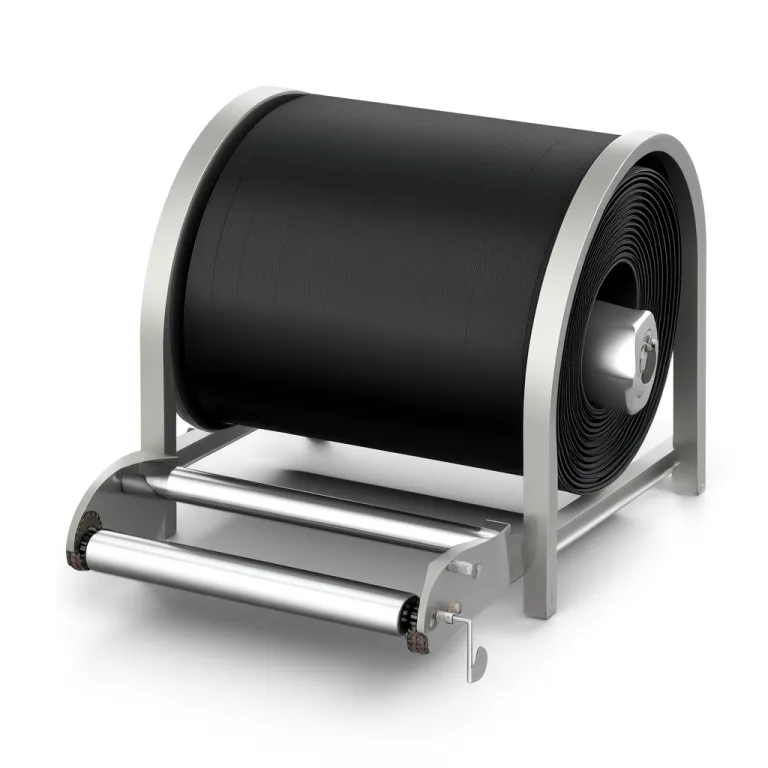
Belt Conveyor
Belt Conveyor for industrial applications.
About Belt Conveyor
Belt Conveyor for industrial applications.
| Domain | automation |
|---|---|
| Product Family | Conveying Equipment |
Who Works With Belt Conveyor?
12 engineering roles are connected to Belt Conveyor based on verified research evidence.
Electrical Engineer
Commissioning Engineer
Control Systems Programmer
PLC Programmer is a widely recognized engineering role in industrial automation, specifically responsible for developing, testing, and maintaining logic programs for PLC controllers. While 'PLC Programmer' is commonly used as a job title, the canonical professional role is more accurately generalized to 'Control Systems Programmer' — a broader but standardized term in ISA, IEC, and IEEE frameworks — acknowledging that PLCs are one implementation within control systems programming (alongside DCS, PACs, and safety controllers). The role directly engages with the PLC Controller product across design, commissioning, troubleshooting, and maintenance phases.
Mechanical Engineer
Facilities Mechanical Engineer is a widely recognized professional role in building services and HVAC engineering, focused on the design, operation, maintenance, and optimization of mechanical systems—including chillers—in commercial and industrial facilities. While 'Facilities' denotes a domain specialization (not product-specific), it does not make the title product-specific (e.g., not 'Chiller Mechanical Engineer'). The role is distinct from generic Mechanical Engineer due to its consistent association with facility infrastructure, lifecycle management, and integrated HVAC system oversight. Evidence from job boards (Indeed) confirms real-world usage with explicit chiller-related responsibilities.
Control Systems Engineer
Motion Control Engineer is a widely recognized, distinct engineering role within industrial automation, specializing in the design, integration, and validation of motion systems—including servo motors, drives, and motion networks (e.g., EtherCAT, CANopen). While 'Motion Control Engineer' includes a domain qualifier ('Motion'), it denotes a well-established specialization—not merely a product-specific title—supported by industry practice (e.g., job postings at Rockwell Automation, Bosch Rexroth, Yaskawa) and professional societies (ISA, IEEE). It generalizes to 'Control Systems Engineer' as the canonical broad role, with 'Motion Control' as a valid, accepted specialization. The role directly engages with servo motors and actuators across the lifecycle: specifying motor/drive combinations, designing motion profiles, commissioning integrated systems, troubleshooting dynamic performance issues, and validating control accuracy.
Automation Engineer
Automation Engineer is a widely recognized professional role in industrial engineering, particularly in contexts involving PLC-based control systems. The evidence explicitly links it to PLC programming at ABB — a major industrial automation vendor — confirming its legitimacy and functional relevance to PLC Controllers. While closely associated with PLCs, the title is not product-specific (e.g., not 'PLC Controller Automation Engineer'), so canonical form remains 'Automation Engineer'. It encompasses system-level design, logic implementation, commissioning, and validation of automated control solutions.
HMI Engineer
HMI Designer is a widely recognized role in industrial automation, specifically focused on designing, configuring, and validating HMI applications for operator interfaces. While 'Designer' suggests a task-oriented label, industry practice (e.g., AutomationDirect, Siemens, Rockwell) treats this as a de facto engineering role requiring domain knowledge of SCADA, PLC integration, tag mapping, and usability validation — aligning with the formal title 'HMI Engineer'. It is product-specific due to the explicit coupling with HMI Panels, but the canonical role generalizes to the established professional title.
Safety Integration Engineer
Safety Integration Engineer is a well-recognized, distinct engineering role in industrial automation—specifically responsible for integrating safety-related control systems (e.g., safety relays, light curtains, safety PLCs) into machinery like belt conveyors. This role ensures compliance with standards such as ISO 13849 and IEC 62061. It is not product-specific (i.e., not 'Belt Conveyor Safety Engineer'), but domain-specific to automation safety; hence canonical_role remains unchanged and product_specific_title = false.
Integration Engineer
Robotics Integration Engineer is a widely recognized engineering role in industrial automation, responsible for integrating robotic systems (e.g., pick-and-place robots) with conveyor-based material handling systems. In the context of belt conveyors, this role designs interface logic, synchronizes motion control between robots and conveyors, validates safety interlocks (per ANSI/ISO), and commissions the integrated system. While 'Robotics' specifies the domain, 'Integration Engineer' is the canonical, broadly accepted title; robotics is a valid and common specialization—not over-specialized—given its distinct body of knowledge, certifications (e.g., RIA), and industry usage.
Electrical Technician
Systems Engineer
‘Senior Mixing Systems Engineer’ is a real, documented job title in beverage and process industries, reflecting a senior-level systems engineering role focused on mixing equipment integration, specification, and lifecycle support. While ‘Mixing Systems’ denotes domain specialization (not vendor- or product-specific like ‘Ribbon Blender Engineer’), it aligns with recognized subdomains of process systems engineering. The canonical role is generalized to ‘Systems Engineer’ per industry standards (INCOSE, IEEE), as ‘Mixing Systems’ is a functional specialization—not a standalone profession. Evidence from active job postings confirms responsibilities directly tied to ribbon blenders: troubleshooting, PM scheduling, GMP documentation, and commissioning—supporting DESIGN, SPECIFY, TROUBLESHOOT, MAINTAIN, and COMMISSION relationships.
Systems Integration Engineer
MES/ERP Integration Specialist is a recognized role in industrial automation, focused on connecting shop-floor equipment (e.g., belt conveyors with VFDs and sensors) to higher-level manufacturing and business systems. While 'MES/ERP Integration Specialist' is a common industry title, the canonical professional role is more accurately generalized as 'Systems Integration Engineer' — a widely accepted engineering discipline under Automation & Control Engineering. The role directly relates to specifying integration requirements, installing/configuring interfaces, commissioning data flows, and testing connectivity for conveyor control systems.