
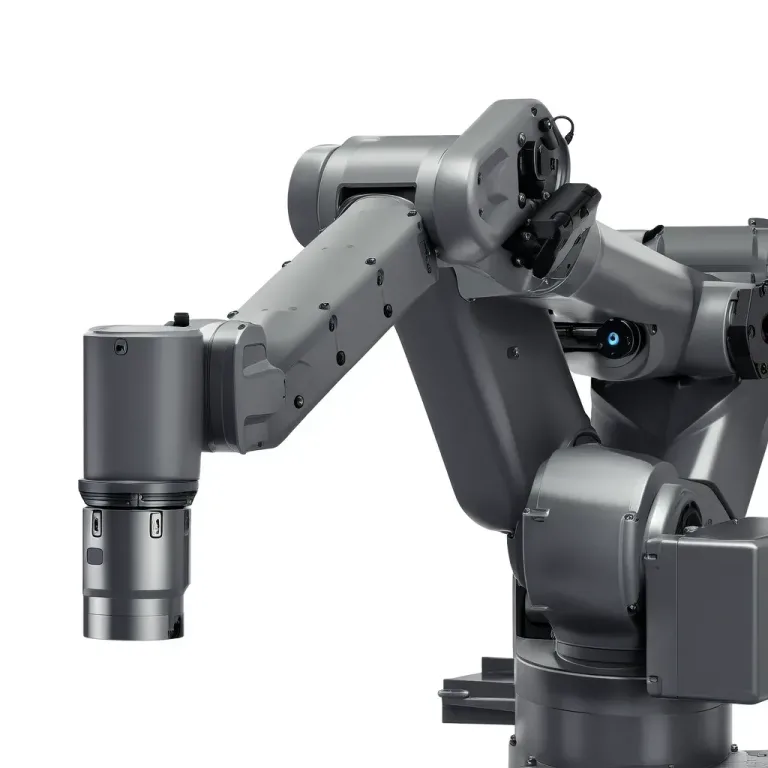
Industrial Robot
机器人: 执行焊接、装配等复杂任务,提高生产效率和质量 — industrial robot for automated manufacturing
About Industrial Robot
机器人: 执行焊接、装配等复杂任务,提高生产效率和质量 — industrial robot for automated manufacturing
| Domain | automation |
|---|---|
| Product Family | Robots |
| Engineering Function | Automated manipulation and positioning of tools or parts in manufacturing processes |
Who Works With Industrial Robot?
6 engineering roles are connected to Industrial Robot based on verified research evidence.
Maintenance Technician
Projects & Engineering Tasks
- Industrial Robot Commissioning Validation SequenceTo verify the safe, accurate, and functionally correct operational readiness of an industrial robot prior to live production use, ensuring mechanical, electrical, and control system alignment.
- Industrial robot safety circuit validation and light curtain interlock verificationTo verify that the safety-related control system of an industrial robot—specifically its light curtain-based presence-sensing interlocks and associated safety circuits—functions correctly to prevent hazardous motion during personnel access, in compliance with functional safety standards.
- Industrial robot tool center point (TCP) alignment and verificationTo establish and validate the precise spatial relationship between the robot’s mechanical axes and its end-effector (e.g., welding gun), ensuring repeatable, accurate, and safe motion execution in production.
- Robotic welding cell commissioning: welding gun calibration and arc welding parameter integrationTo ensure precise, repeatable, and process-stable arc welding execution by a robotic system through mechanical alignment of the welding gun and systematic integration of welding parameters into the robot controller and power source.
- Welding cell commissioningTo verify, validate, and integrate all subsystems of an automated welding cell—robot, weld equipment, safety systems, PLC controls, and I/O interfaces—so that the cell operates safely, reliably, and to specification under production conditions.
Mechanical Engineer
Facilities Mechanical Engineer is a widely recognized professional role in building services and HVAC engineering, focused on the design, operation, maintenance, and optimization of mechanical systems—including chillers—in commercial and industrial facilities. While 'Facilities' denotes a domain specialization (not product-specific), it does not make the title product-specific (e.g., not 'Chiller Mechanical Engineer'). The role is distinct from generic Mechanical Engineer due to its consistent association with facility infrastructure, lifecycle management, and integrated HVAC system oversight. Evidence from job boards (Indeed) confirms real-world usage with explicit chiller-related responsibilities.
Projects & Engineering Tasks
- DFMA and Tolerance Stack-Up Analysis for Robotic Welding FixturesTo ensure robotic welding fixtures are manufacturable, assembleable, and dimensionally robust by integrating design-for-manufacture-and-assembly principles with rigorous geometric tolerance analysis to guarantee weld repeatability, part fit, and compliance with safety and functional requirements.
- Industrial Robot Integration Scope DefinitionTo formally define the mechanical and operational boundaries that govern how an industrial robot interacts with its environment—ensuring safe, repeatable, and process-capable deployment within a manufacturing cell.
- Robotic welding cell integration projectTo design, configure, and validate a fully functional robotic welding cell that meets production requirements for quality, cycle time, safety, and interoperability with existing manufacturing infrastructure.
- Robotic welding cell structural and thermal design integrationTo ensure the robotic welding cell maintains structural integrity under dynamic operational loads and achieves stable thermal performance during continuous duty cycles, enabling safe, repeatable, and high-quality welds without thermal drift or mechanical fatigue.
- Welding Cell Mechanical Integration ProjectTo enable reliable, repeatable, and high-quality robotic arc welding by designing and validating the mechanical interface between the industrial robot, workpiece, and welding torch within a production cell.
Industrial Engineering Technician
Industrial Engineering Technician is a widely recognized, standardized occupational title (e.g., U.S. BLS SOC 17-3025, O*NET) with defined duties in designing, implementing, and optimizing automated manufacturing systems—including robotic workcells, production lines, and integrated automation solutions. The evidence explicitly links them to robotics, automation, and production line optimization in the context of industrial robots performing welding and assembly.
Projects & Engineering Tasks
- Automated Welding System CommissioningTo verify, validate, and hand over a fully functional, safe, and production-ready automated welding system integrated with industrial robots, ensuring conformance to process specifications, safety standards, and operational requirements.
- Industrial Robot Welding Cell CommissioningTo safely and functionally integrate, validate, and hand over a robotic welding cell to production readiness, ensuring compliance with safety standards, process repeatability, weld quality, and interoperability with upstream/downstream automation systems.
- Robot Welding Cell CommissioningTo safely and reliably bring a robotic welding cell into operational service by verifying mechanical integrity, electrical safety, control system functionality, sensor accuracy, and production performance against design specifications.
- Robotic Arc Welding System CommissioningTo verify, validate, and document that a robotic arc welding system operates safely, reliably, and in accordance with design specifications, process requirements, and applicable safety standards prior to handover for production use.
- Robotic Welding Cell CommissioningTo verify safe, reliable, and code-compliant operation of an integrated robotic welding cell prior to handover for production use.
Robotics Technician
Industrial robot technicians are a well-established occupational role in automation and manufacturing engineering, with standardized responsibilities directly tied to industrial robots. While 'Industrial robot technician' contains a product-specific modifier ('industrial robot'), the canonical professional role is 'Robotics Technician' — a widely recognized title in industry (e.g., O*NET SOC 17-3026.00, ISO/IEC JTC 1/SC 42 standards on AI and robotics workforce). Their duties align precisely with installation, maintenance, troubleshooting, programming, calibration, and safety inspection of robotic systems.
Robotics Engineer
Robotics Engineer is a widely recognized professional engineering role in automation and industrial robotics domains; the evidence explicitly states they design, build, test, and deploy robotic systems—including industrial robots—and collaborate with operators/technicians for reliability and efficiency.
Operator
Operators are a well-established, widely recognized professional role in industrial automation contexts. In robotic manufacturing, Operators oversee and monitor robot execution of tasks (e.g., welding, assembly), ensure safe operation, perform routine visual/functional checks, and intervene when anomalies occur — aligning with OPERATE and INSPECT relationships. The term is generic (not product-specific) and distinct from technicians or engineers; it reflects a core frontline production role.
Projects & Engineering Tasks
- ABB robotic welding cell commissioningTo safely, reliably, and repeatably integrate and validate an ABB industrial robot-based welding cell for production use in accordance with functional specifications, safety standards, and customer acceptance criteria.
- Industrial Robot Welding Cell CommissioningTo safely and functionally integrate, validate, and hand over a robotic welding cell to production readiness, ensuring compliance with safety standards, process repeatability, weld quality, and interoperability with upstream/downstream automation systems.
- KUKA KR C5 robotic welding cell integration and commissioningTo safely and functionally integrate a KUKA KR C5 industrial robot into a complete, production-ready robotic welding cell—including mechanical, electrical, safety, control, and process subsystems—and verify conformance to operational, quality, and safety requirements.
- Robotic welding cell commissioning with TCP verification and cycle-time validationTo verify that an industrial robotic welding system operates safely, repeatably, and in accordance with design specifications for tool center point (TCP) positioning accuracy and production cycle time.
- Welding robot cell commissioningTo configure, validate, and verify the functional readiness of a robotic welding cell for safe, repeatable, and production-capable operation in accordance with process specifications and safety standards.