
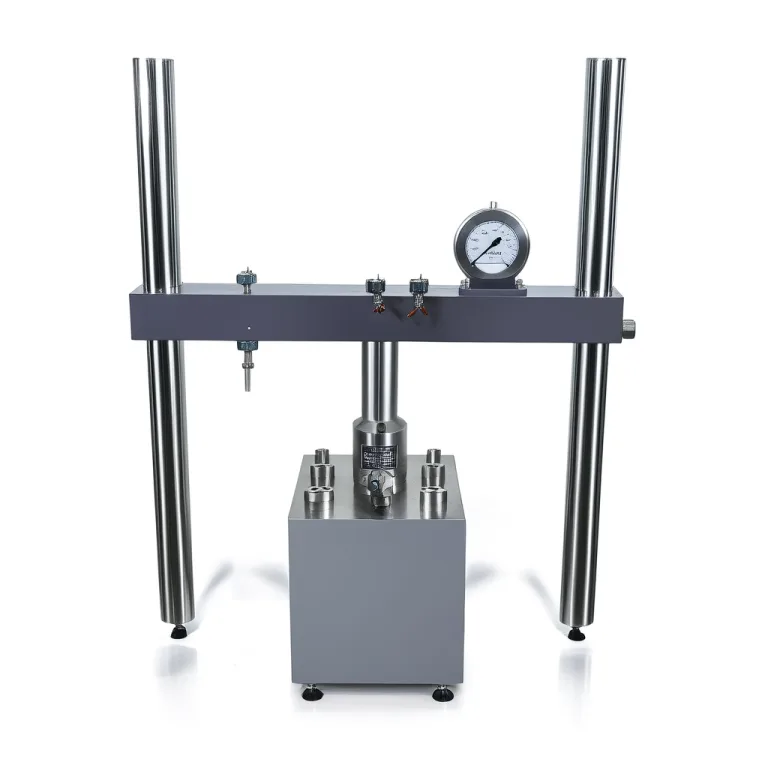
Torsion Testing Machine
Torsion Testing Machine for industrial applications.
About Torsion Testing Machine
Torsion Testing Machine for industrial applications.
| Domain | automation |
|---|
Who Works With Torsion Testing Machine?
10 engineering roles are connected to Torsion Testing Machine based on verified research evidence.
Quality Engineer
Validation Engineer
Validation Engineer is a well-established professional role in regulated industries (e.g., pharmaceuticals, chemicals, food & beverage), responsible for verifying that equipment and systems perform as intended under specified operating conditions. In the context of cartridge filter housings for corrosive chemical plant environments, this role directly engages in validation protocols — including design qualification (DQ), installation qualification (IQ), operational qualification (OQ), and performance qualification (PQ) — to ensure compliance with safety, material compatibility, and filtration integrity requirements. The evidence confirms validation activities are explicitly referenced alongside specification and inspection for this product.
Quality Assurance Engineer
QA/QC team member is a widely recognized role in industrial manufacturing, especially in high-precision composite production like carbon fiber prepreg lines. While 'team member' is generic, the context of collaboration with QA/QC teams in prepreg line operations implies a formal quality assurance function. The canonical role is standardized to 'Quality Assurance Engineer' — a broadly accepted professional title encompassing both QA and QC responsibilities in engineering manufacturing. In carbon fiber prepreg contexts, this role directly inspects raw materials (e.g., resin content, fiber alignment), tests cured samples (e.g., Tg, void content), and maintains process compliance — hence INSPECT, TEST, and MAINTAIN (of quality systems/processes). 'QA/QC team member' is not product-specific (no carbon/prepreg embedded in title), so product_specific_title = false.
Research and Development Engineer
R&D Engineer is a widely recognized professional role in engineering domains, including automation and mechanical test equipment. In the context of torsion testing machines, R&D Engineers contribute to design innovation, performance validation (e.g., compliance with ASTM E143/ISO 7800), and specification of functional requirements. The evidence confirms collaboration with QA and involvement in calibration and system operation — aligning with DESIGN, TEST, and SPECIFY relationships. 'R&D' is a standard functional specialization, not product-specific.
Installation Engineer
Installation Engineer is a widely recognized professional role in industrial automation and test equipment domains, specifically responsible for on-site setup, mechanical/electrical integration, safety validation, and functional commissioning of complex machinery like torsion testing machines. Evidence confirms involvement in installation, IQ/OQ/PQ validation, and user training — all core responsibilities of this role. While 'Installation' is a task, 'Installation Engineer' denotes a formal job title with defined competencies (e.g., mechanical alignment, control system interfacing, documentation per ISO/IEC 17025 or GAMP), distinct from generic technicians.
Training Specialist
Customer Trainer is a recognized professional role in industrial automation, especially for HMI/Operator Interface products where end-user competency directly impacts safe and effective operation. Rockwell Automation explicitly references 'HMI Panel Technician' roles supporting field service and customer training, confirming that training delivery to customers is a formalized function tied to product deployment. While 'Customer Trainer' contains a stakeholder descriptor ('Customer'), it denotes a distinct job function — designing/delivering technical training on how to operate, navigate, and troubleshoot HMIs — and is widely used as a title (e.g., Siemens Customer Training Engineer, Schneider Electric Training Consultant). It generalizes to 'Training Specialist' (a canonical HR/ATS-recognized role) with specialization in automation; no product-specific prefix (e.g., 'HMI Customer Trainer') is present, so product_specific_title = false.
Test Technician
Dew point verification is a specialized test activity critical for validating dryer performance in compressed air systems; while 'dew point verification specialist' is not a widely standardized job title, it describes a practitioner performing calibrated moisture measurement and compliance verification — functionally aligned with Test Technician (especially HVAC/industrial gas systems), with specialization in dew point metrology. The role directly relates to commissioning, inspection, and performance testing of compressed air dryers.
Laboratory Technician
Laboratory Technician is a widely recognized professional role in industrial and chemical contexts, responsible for performing analytical tests (e.g., filtrate clarity testing) to verify process performance and product quality. The evidence explicitly links sampling and testing of filtrate clarity — a core quality control activity — to the Filter Press operation, placing the Laboratory Technician in a direct testing and inspection relationship with the product.
Materials Engineer
Materials Engineer is a widely recognized professional engineering role. In the context of a Ceramic Ball Mill — a product whose performance critically depends on ceramic material properties (e.g., wear resistance, thermal stability, fracture toughness) — a Materials Engineer contributes to material selection, formulation optimization (evidenced by 'knowledge of ceramic formulations'), design validation, and testing of ceramic components (e.g., liners, grinding media). While specialization in ceramics is implied, 'Materials Engineer' remains the canonical, discipline-level role; 'Ceramic Materials Engineer' would be a specialization but is not the input text.