
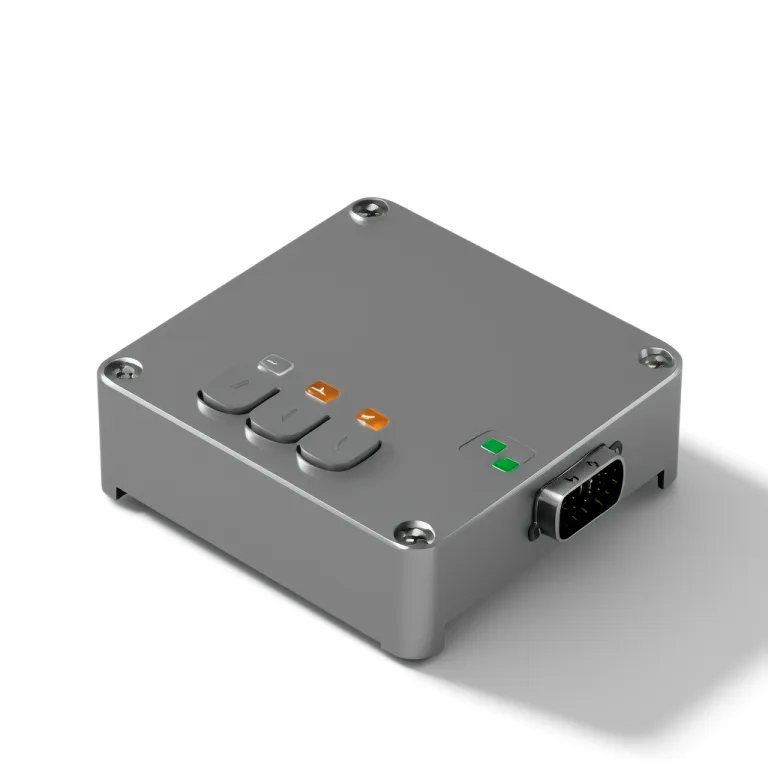
Train Control Unit
Train Control Unit for industrial applications.
About Train Control Unit
Train Control Unit for industrial applications.
| Domain | automation |
|---|
Who Works With Train Control Unit?
10 engineering roles are connected to Train Control Unit based on verified research evidence.
Automation Engineer
Automation Engineer is a widely recognized professional role in industrial engineering, particularly in contexts involving PLC-based control systems. The evidence explicitly links it to PLC programming at ABB — a major industrial automation vendor — confirming its legitimacy and functional relevance to PLC Controllers. While closely associated with PLCs, the title is not product-specific (e.g., not 'PLC Controller Automation Engineer'), so canonical form remains 'Automation Engineer'. It encompasses system-level design, logic implementation, commissioning, and validation of automated control solutions.
Validation Engineer
Validation Engineer is a well-established professional role in regulated industries (e.g., pharmaceuticals, chemicals, food & beverage), responsible for verifying that equipment and systems perform as intended under specified operating conditions. In the context of cartridge filter housings for corrosive chemical plant environments, this role directly engages in validation protocols — including design qualification (DQ), installation qualification (IQ), operational qualification (OQ), and performance qualification (PQ) — to ensure compliance with safety, material compatibility, and filtration integrity requirements. The evidence confirms validation activities are explicitly referenced alongside specification and inspection for this product.
PLC Programmer
PLC Programmer is a widely recognized professional role in industrial automation engineering, responsible for developing, debugging, and maintaining control logic for machines like the Battery Cell Stacking Machine. The evidence explicitly links PLC programming to the product’s functionality (e.g., motion control, sequencing, safety interlocks), confirming direct involvement in design, commissioning, troubleshooting, and maintenance.
Signalling Engineer
Rail Signalling Engineer is a well-established professional role in rail infrastructure engineering; the parenthetical '(Point Machine Specialist)' denotes a domain-specific specialization aligned with the product context (Point Machine for industrial applications). While 'Point Machine' is product-specific, 'Signalling Engineer' is the canonical, widely recognized role title used across standards (e.g., RSSB, IRSE, CENELEC EN 50126/8/9) and industry practice. This role directly engages with point machines across the lifecycle — specifying interfaces, commissioning control logic, testing safety integrity (SIL), troubleshooting failures, and maintaining system reliability.
Software Developer
Software developer is a widely recognized professional role in engineering contexts. In the domain of automation and SIL-compliant Train Control Units, this role specifically engages in designing, implementing, verifying, and commissioning safety-critical embedded software per IEC 61508/EN 50128. The evidence of 'SIL-compliant software development' confirms involvement in safety lifecycle activities directly tied to the product.
Control Systems Engineer
Motion Control Engineer is a widely recognized, distinct engineering role within industrial automation, specializing in the design, integration, and validation of motion systems—including servo motors, drives, and motion networks (e.g., EtherCAT, CANopen). While 'Motion Control Engineer' includes a domain qualifier ('Motion'), it denotes a well-established specialization—not merely a product-specific title—supported by industry practice (e.g., job postings at Rockwell Automation, Bosch Rexroth, Yaskawa) and professional societies (ISA, IEEE). It generalizes to 'Control Systems Engineer' as the canonical broad role, with 'Motion Control' as a valid, accepted specialization. The role directly engages with servo motors and actuators across the lifecycle: specifying motor/drive combinations, designing motion profiles, commissioning integrated systems, troubleshooting dynamic performance issues, and validating control accuracy.
Test Engineer
Thermal Test Engineer is a recognized engineering role specializing in thermal performance evaluation; evidence confirms its use in HVAC contexts involving heat flux sensors, data logging, and system diagnostics. While 'thermal' denotes a domain specialization, the core role is 'Test Engineer'—a widely accepted professional title in engineering practice. It is not product-specific (e.g., not 'Heat Flux Sensor Test Engineer'), so product_specific_title = false.
Certification Engineer
Certification Engineer is a widely recognized professional role in safety-critical automation domains (e.g., rail, industrial control), responsible for ensuring compliance with standards (e.g., EN 50126/8/9, IEC 61508, ISO 13849) during design, testing, and commissioning of systems like Train Control Units. The evidence explicitly links certification to TCU development.
Systems Engineer
‘Senior Mixing Systems Engineer’ is a real, documented job title in beverage and process industries, reflecting a senior-level systems engineering role focused on mixing equipment integration, specification, and lifecycle support. While ‘Mixing Systems’ denotes domain specialization (not vendor- or product-specific like ‘Ribbon Blender Engineer’), it aligns with recognized subdomains of process systems engineering. The canonical role is generalized to ‘Systems Engineer’ per industry standards (INCOSE, IEEE), as ‘Mixing Systems’ is a functional specialization—not a standalone profession. Evidence from active job postings confirms responsibilities directly tied to ribbon blenders: troubleshooting, PM scheduling, GMP documentation, and commissioning—supporting DESIGN, SPECIFY, TROUBLESHOOT, MAINTAIN, and COMMISSION relationships.
Automation Integration Engineer
HMI integrator is a widely recognized role in industrial automation, particularly for safety-critical systems like Train Control Units. While 'HMI integrator' is product- and domain-specific (emphasizing HMI layer integration), it maps to the broader, standardized engineering role of Automation Integration Engineer — a recognized function responsible for integrating HMIs with control hardware (e.g., TCUs), configuring communication protocols, validating operator interfaces, and ensuring functional safety compliance. The role directly engages in design, installation, commissioning, and testing of the HMI subsystem within the TCU ecosystem.